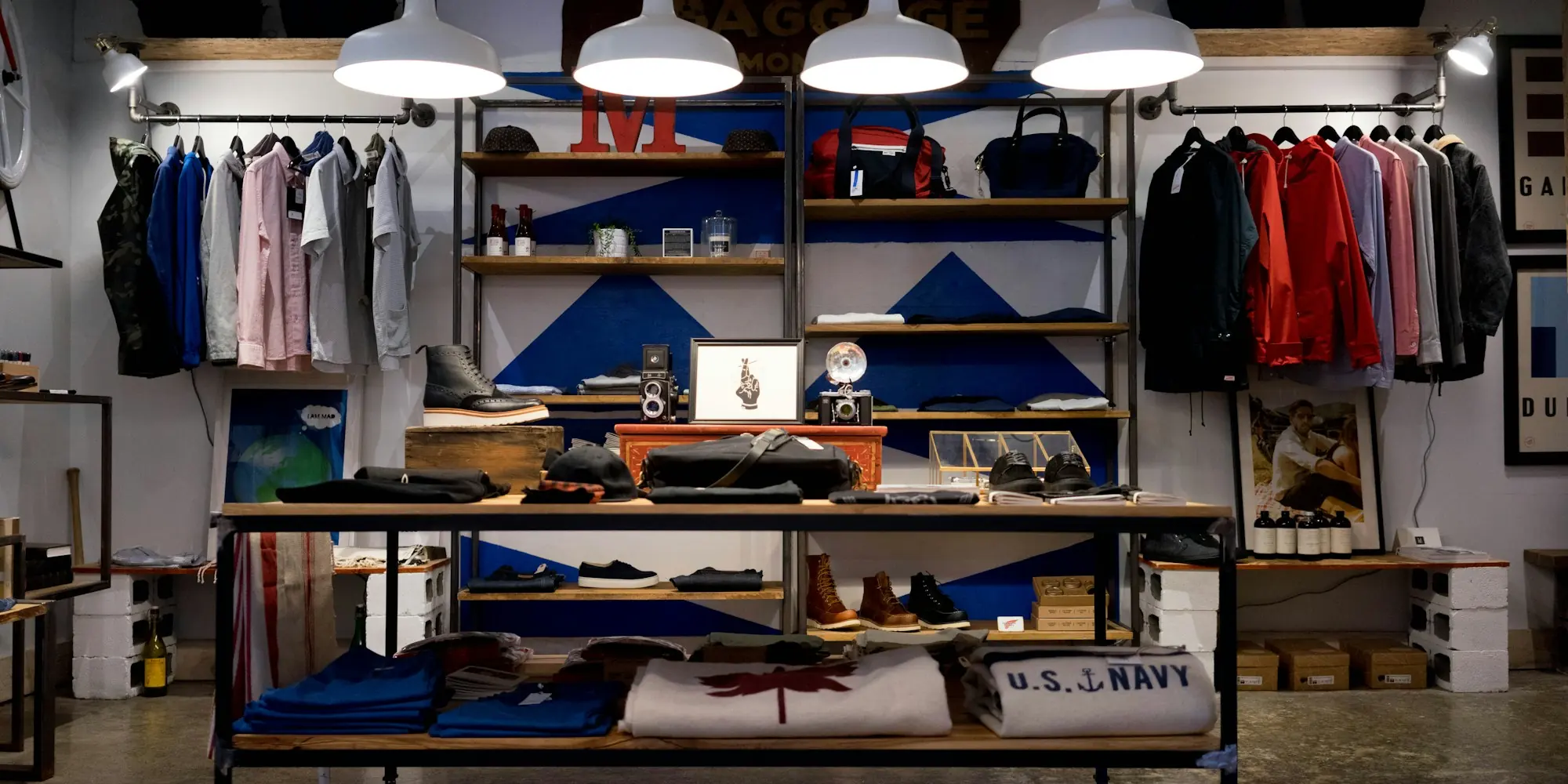
Most retail stores pay for inventory, fixtures, renovations and the slow months after the holidays with 4 kinds of financing. A line of credit is the usual way to finance inventory, because you draw it when the season's order is due and pay it down as the stock sells. Revenue-based financing, often called a merchant cash advance, is sized on your usual revenue and repaid with a set daily or weekly payment. Equipment financing covers a POS system or refrigerated cases, and SBA and bank loans cover a remodel or a second location over terms of several years. Which one fits depends on how quickly the purchase earns back what it cost.
For a store, that usually means inventory, since holiday stock is ordered in late summer and paid for before most of it sells. Below, we cover how each option works in a shop, how the slow months after a peak affect repayment, and what funders look at. Our retail funding page has a shorter overview.
Why retail cash flow is uneven
Retail sales are concentrated at the end of the year. The National Retail Federation reported that core retail sales during the 2024 holiday season, which it counts as November 1 through December 31, reached $994.1 billion, out of $5.28 trillion for the whole year. That puts close to 19% of the year's core retail sales into 2 months that would hold about 17% if sales were spread evenly.
For many kinds of store the difference is much bigger. In the Census Bureau's monthly retail trade estimates for 2025, before seasonal adjustment, clothing and accessory stores sold $39.1 billion in December and $18.2 billion in January, so December brought in more than twice as much as the month after it. For hobby, toy and game stores, November and December made up 27% of the year. Online sellers follow the same pattern, with electronic shopping and mail-order houses selling $139.3 billion in December against $90.9 billion in February.
The peak is not always December. Building material and garden stores peaked in May 2025, about 49% above their February low, and gift and souvenir stores had their biggest month in October. Whatever the month, you pay for stock before the peak and get the money back during it, while rent and payroll continue through the slow months before and after. In the Federal Reserve's 2025 Report on Employer Firms, 56% of small employer firms had trouble paying operating expenses (the survey's examples are payroll, rent and inventory costs) and 51% reported uneven cash flow.
How to finance inventory for a retail store
Money spent on inventory is tied up until a customer buys it, so how you finance it depends on how fast the stock sells.
A line of credit for seasonal orders
A line of credit gives you a limit, up to $2,000,000 through our network, and you draw only what you need. You repay what you drew on a weekly or monthly schedule, and you can draw again as you repay. As an example, a gift shop might draw $40,000 in September for its holiday order and another $15,000 in November to reorder what is selling, then pay the balance down through December and January as that stock sells. A line can also pay for seasonal staff hired before the busy season. Our line of credit page explains limits, draws and repayment.
Supplier terms and inventory loans elsewhere
Before borrowing, ask your suppliers for longer terms, since net 30 or net 60 on a holiday order means part of the stock is sold before the invoice is due. Some lenders offer inventory loans secured by the stock itself, or purchase order financing that pays a supplier for one large order. We do not arrange either of those, but they are offered elsewhere and are worth asking about if your stock is large and closely tracked. Invoice factoring, for stores with wholesale accounts, is also offered elsewhere.
The SBA's seasonal line
The SBA's CAPLines program includes a Seasonal CAPLine, which finances seasonal increases in receivables and inventory, and in some cases the extra labor that comes with them. It goes through a lender and takes weeks, so it suits a store that plans its buying a season ahead.
Card-sales-based funding for retail
Most store revenue arrives by card. The Federal Reserve's 2025 Diary of Consumer Payment Choice found that credit cards made up 35% of all consumer payments in 2024 and debit cards another 30%, while cash had fallen to 14%. Card sales and online payouts are deposited in the business account almost every day, and a revenue-based funder looks at those deposits.
With revenue-based financing, a funder buys a share of your future sales at a discount. It pays you a lump sum now and collects a larger fixed total by daily or weekly debit until that total is reached. Advances arranged through us range from $5,000 to $2,000,000, typically fund in 1-2 business days, and usually need no collateral. They are priced with a factor rate instead of an interest rate, so as an example, a factor rate of 1.25 on a $30,000 advance means $37,500 paid back in total, however long it takes.
An advance suits a short need with a clear payoff, such as reordering a product that sold out in the first week of December. A project that takes years to pay for itself, such as a remodel or a second location, fits an SBA or bank loan better. Our revenue-based financing page covers amounts, timing and fit.
Renovations, fixtures and a second location
Equipment financing pays for a specific piece of equipment and uses it as security. In a store, that usually means a POS system, refrigerated cases for a grocer or convenience store, security systems, or a forklift and a delivery van. Because the funder can recover the equipment, approval tends to be easier. In the Fed's survey, 68% of applicants for auto or equipment loans were fully approved, against 47% for business lines of credit, 33% for merchant cash advances and 32% for SBA loans. Our guide to how equipment financing works covers terms and ownership.
Renovations and built-in fixtures are harder to finance that way, because flooring, lighting and custom shelving cannot be taken back and resold. For those, and for a second location, SBA and bank loans are the usual choice. The SBA's 7(a) program lends up to $5 million for uses that include working capital, furniture and fixtures, and buying or improving buildings. The 504 program lends up to $5 million, or $5.5 million for some projects, for major fixed assets such as the building itself, but not for working capital or inventory. Both take weeks and ask for tax returns, a personal financial statement and a debt schedule. Our SBA and bank loans page lists what lenders ask for.
The term matters most for a second store. The new location pays rent and staff from the day it opens and may take a season or more to reach the first store's sales. If the buildout is paid with a short advance, those payments come out of the first store while the second is still building up customers.

The slow months after the peak
January and February show whether a store's financing fits. Sales in some categories fall by half, the holiday staff are gone, and any payment set during the busy season keeps coming due.
This is why the size of the payment can matter as much as the price. Take an example clothing boutique that averages $50,000 a month and follows the national pattern for clothing and accessory stores, so it brings in about $78,200 in December and $36,400 in January. A set payment of $5,000 a month, sized on the average month, takes 6.4% of December's sales and 13.7% of January's. Sized on January instead, at about $3,600, it never takes much more than 10% of a month's sales, and the advance runs a little longer. All of these figures are illustrative.
Many advances set a fixed daily or weekly payment that estimates the agreed share, then let you ask for a lower payment if sales fall. That adjustment is called reconciliation. Before you sign, ask who decides, what you have to send, and how quickly the payment changes, because an advance whose reconciliation is hard to use works much like a fixed loan in February.
The easiest time to arrange money for a peak is a few weeks before you place the order, when you have time to compare offers. We wrote more about that in our post on arranging funding before the busy season.
What funders look at in a retail file
Every funder sets its own thresholds, and they vary widely. Revenue-based funders base most of their decision on your last 4 months of business bank statements, looking at monthly deposits and how steady they are, how often the balance gets low, and what other debits already come out, especially daily payments to other funders. A store that applies in late January shows its weakest months, so say that the business is seasonal and have the prior holiday season's statements ready if a funder asks. In the Fed survey, 48% of applicants with 5 years or less in business were fully approved, compared with 64% of firms open 21 years or more, and 49% of retail applicants were fully approved.
Credit matters more to some funders than to others, and most prequalify from bank statements and a soft credit pull. If you are looking for small retail store funding with bad credit, a low score means fewer funders, but it does not rule you out, and steady card deposits count for a lot. Our guide to qualifying for a merchant cash advance goes through the requirements.
Matching the need to the financing
| Need | What tends to fit | Why |
|---|---|---|
| Holiday inventory ordered in late summer | A line of credit, or a Seasonal CAPLine if there is time | You draw for the order and repay as the stock sells. |
| A December reorder of a best seller | A short revenue-based advance or a line draw | The stock sells within weeks, during the busiest sales of the year. |
| A new POS system or refrigerated cases | Equipment financing | The equipment secures the financing over a term close to its working life. |
| A remodel or built-in fixtures | An SBA 7(a) or bank loan | The work pays for itself over years, so a longer term keeps the payment in line with it. |
| A second location | An SBA 7(a) loan, with equipment financing for registers and cases | A short repayment would come out of the first store while the second builds sales. |
Mistakes that cost stores the most
The mistake we most often help store owners fix is stacking, which means taking a second or third advance while the first is still being repaid. Each new advance adds another debit to the same account, and offers for a second position are usually priced higher because the first funder has priority. A store that takes one advance for its holiday order and another to get through January ends up with 2 debits in the slowest weeks of the year. Consolidation replaces several advances with a single weekly or monthly payment on a longer term, with the new funder paying the old ones directly, though the total cost may not go down.
The second mistake is borrowing to buy more stock than the season will sell. Stock left in January still has to be paid for, and a markdown plus the financing cost can turn a good season into a loss. Size the draw to what sold last year, and keep some of the line free for reorders of what sells.
The third mistake is signing the first offer without comparing it. Offers on the same file can differ in total payback, payment frequency and early payoff terms, and for a seasonal store a weekly payment can be easier to manage in February than a slightly cheaper daily one.

How to apply for retail financing
- Fill out the short application with your monthly revenue, time in business and what the money is for. There is nothing to pay to apply or to see offers, and no obligation to accept one.
- Add your last 4 months of business bank statements as PDFs. For an SBA or bank loan, have tax returns, a personal financial statement and a list of current debts ready too.
- We send your file to the funders in our network, show you their offers together, and go through the total payback, payment and early payoff terms with you before you sign.
- Most applicants are funded within 1-2 business days of choosing an offer, and some the same day. SBA and bank loans take several weeks.
Say what the money is for when you apply, because a holiday order and a remodel need different products. If you also run a café inside the store, our guide to restaurant financing covers that side, and our retail page sums up what tends to fit a shop. To talk it through first, call us at (818) 351-0225.
Questions retail owners ask about financing
How do you finance inventory for a retail store?
Most stores use a line of credit, drawing when the season's order is due and paying it down as the stock sells, or a short revenue-based advance for a specific reorder. Longer supplier terms help too, and the SBA's Seasonal CAPLine finances seasonal inventory if you can wait several weeks.
Can a small retail store get funding with bad credit?
Many can, though with fewer options. Revenue-based funders base most of their decision on bank statements and card deposits, so a low score means fewer funders, but it does not rule you out.
Is a merchant cash advance a good idea for a retail business?
It can be for stock that will sell within weeks, because the money arrives quickly and the set payment is sized on your usual revenue. It fits a remodel or a second location poorly, so check the total payback, payment frequency and reconciliation terms before you sign.
How fast can a retail store get funding?
Most applicants are funded within 1-2 business days of choosing an offer, and some the same day. SBA and bank loans take several weeks.
What documents does a retail business need to apply for financing?
For most products you need a short application and your last 4 months of business bank statements. SBA and bank lenders also ask for tax returns, a personal financial statement and a debt schedule. Our guide to small business loan requirements lists what each type of lender checks.
Does applying for retail financing hurt my credit score?
Getting matched with funders does not need a hard credit pull, since most funders prequalify from bank statements and a soft pull. A funder may run a hard pull in final underwriting, and you will know before it does.