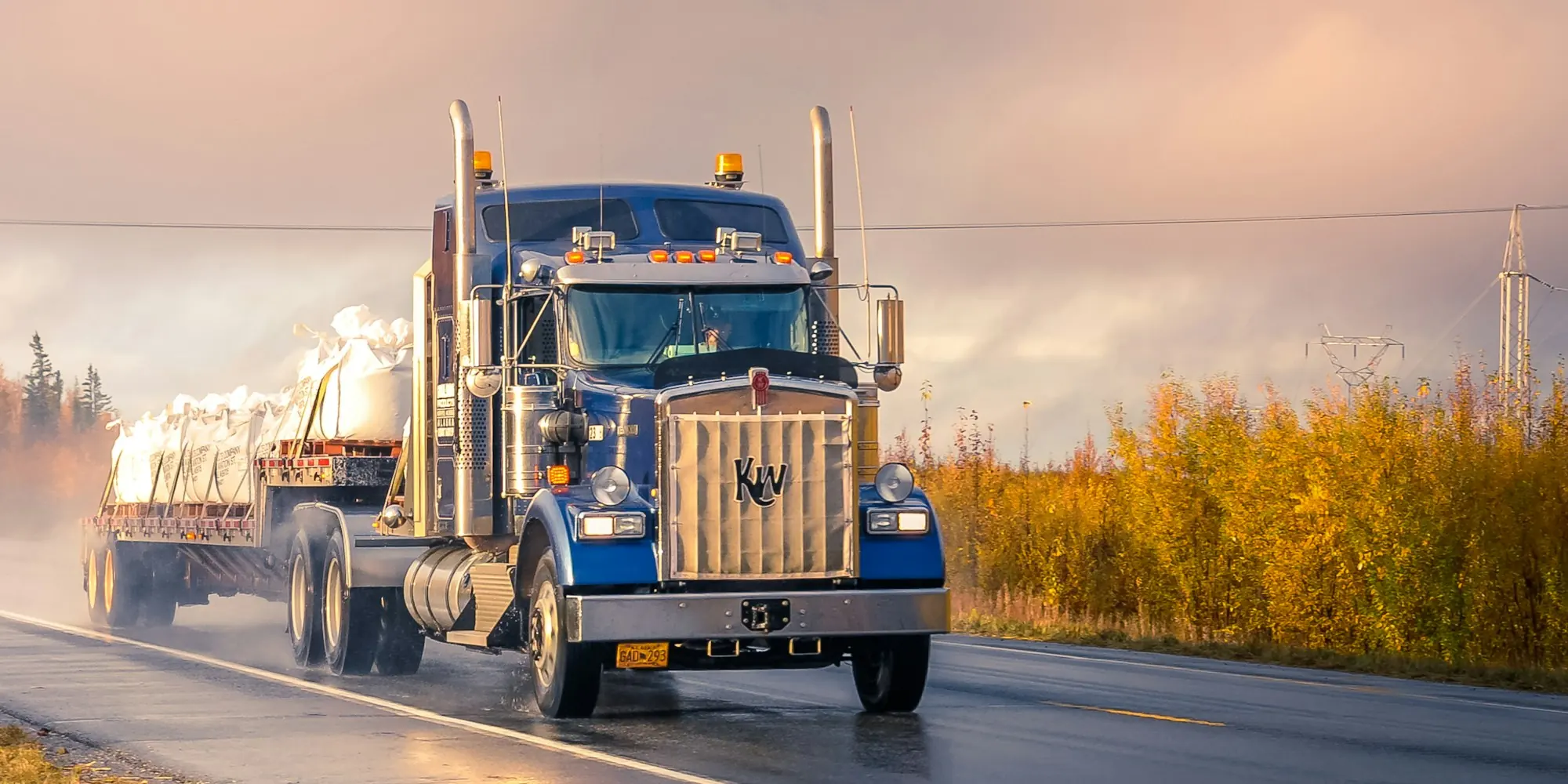
Owner-operators and small fleets usually finance a trucking business with a few types of financing, each matched to a different cost. Equipment financing buys tractors and trailers and uses the truck itself as security. A line of credit covers fuel, driver pay and insurance down payments during the 30 to 60 days it takes brokers and shippers to pay. Revenue-based financing, often called a merchant cash advance, pays for a sudden repair and is repaid from the deposits that follow. SBA and bank loans fit larger plans that can wait several weeks. Freight factoring is common in trucking too, and although we do not arrange it, we explain below how it compares with the others.
Most of the industry is small. The American Trucking Associations' 2025 edition of American Trucking Trends found that 91.5% of carriers operate 10 or fewer trucks. For those carriers, payment comes in weeks after the costs of the load are paid, and the truck that brings in the money can also break down. Funders differ widely on trucking, so the same file can be declined by one and funded by the next. Our trucking funding page gives a shorter overview of how we handle fleets.
Why trucking businesses run low on cash between loads
A load is usually invoiced to a broker or shipper on 30 to 45 day terms, and some large shippers take longer. The diesel to haul it was paid for when the truck fueled up, drivers are paid weekly, and the truck payment, insurance and permits come due on their own dates. The Federal Reserve's 2025 Small Business Credit Survey report on employer firms found that 51% of small employers struggled with uneven cash flow, which the survey defines to include collecting on receivables, and 56% struggled to pay operating expenses.
The costs are large and steady. The American Transportation Research Institute's 2025 analysis of the operational costs of trucking put the average cost of running a truck in 2024 at $2.260 per mile. Costs other than fuel came to $1.779, which leaves fuel at roughly 48 cents a mile, and truck and trailer payments alone reached a record 39 cents. ATRI also found average operating margins below 2% in every sector except less-than-truckload, with truckload carriers averaging minus 2.3%.
Take an example truck that runs 2,500 miles a week. At those averages it spends about $1,200 a week on fuel and about $975 on truck and trailer payments, roughly $2,180 before driver pay, insurance, tires or tolls. If its brokers pay on 30-day terms, about 4 weeks of those costs, close to $8,700, are paid before the first invoice is paid. On 45-day terms it is about 6 weeks, or roughly $13,000. These figures are illustrative, and ATRI's averages combine fleets of every size and sector.
Once invoice payments arrive every week, the gap stops growing, but it stays for as long as the truck runs. A second truck roughly doubles it.
The main ways to finance a trucking business
Equipment financing for trucks and trailers
Equipment financing is the usual way to finance a semi truck. A funder pays for a specific tractor, trailer or piece of shop equipment and holds a security interest in it until it is paid off. Because the funder can recover the equipment if payments stop, it tends to be easier to obtain than unsecured credit. In the Fed survey, 68% of applicants for auto or equipment loans were fully approved, the highest share of any product listed, compared with 47% for business lines of credit and 32% for SBA loans. Offers through our network usually come back within 1-2 business days.
A lower-priced used tractor may suit a new authority better than a new truck with a payment that is hard to cover in a bad month, and funders weigh the truck's age, mileage and price as well as your business. Our equipment financing page lists what it covers, and our guide to how equipment financing works goes through terms and down payments.
Line of credit
A line of credit gives you a limit, up to $2,000,000 through our network, and you draw only what you need. You repay what you drew on a weekly or monthly schedule, and you can draw again as you repay. In trucking, a line fits the ongoing gap between paying for a load and being paid for it, since you draw for fuel and payroll and pay the line down as broker payments arrive. It also suits costs that come up every year, such as an insurance down payment at renewal or the federal heavy vehicle use tax, which under 26 U.S.C. 4481 is $550 a year for a truck over 75,000 pounds. Our line of credit page explains limits and repayment.
Revenue-based financing, or a merchant cash advance
With revenue-based financing, a funder buys a share of your future revenue at a discount. It pays you a lump sum now and collects a larger fixed total, usually by daily or weekly debit, until that total has been collected. Advances arranged through us range from $5,000 to $2,000,000, typically fund in 1-2 business days and usually need no collateral. They are priced with a factor rate, so as an example, a factor rate of 1.30 on a $30,000 advance means $39,000 paid back in total.
An advance fits a repair that has to happen now, like a transmission or a set of steer tires, since the truck makes no money while it is in the shop. It fits a long-term purchase poorly, because it is usually repaid within months. Trucking deposits also come in large, uneven amounts when brokers pay several invoices at once, so ask how the payment is set and whether it can be adjusted if a slow lane lowers your deposits. Our revenue-based financing page covers amounts and fit.
SBA and bank loans
SBA and bank loans take weeks and ask for tax returns, a personal financial statement and a schedule of current debts, and in exchange they offer the longest terms. The SBA's 7(a) program lends up to $5 million for working capital, equipment, real estate and refinancing business debt, and its Working Capital Pilot offers lines of credit to businesses that want to borrow against accounts receivable. They suit a carrier with several years of tax returns and a plan that can wait, such as buying a yard. Our SBA and bank loans page lists what lenders ask for.
Freight factoring and how it compares
Freight factoring is common in trucking, but we do not arrange it. A factoring company buys your unpaid freight invoices, pays you most of their value up front, and collects from the broker or shipper, who is usually told to pay the factor directly. As an example, a factor charging 3% on a $3,000 invoice would pay the carrier $2,910. At that rate, a truck billing $250,000 a year would pay $7,500 a year in fees if it factored every load. Real fees vary by factor and volume.
Read a factoring agreement closely. With recourse factoring you buy the invoice back if the broker never pays, while non-recourse factoring shifts some of that risk to the factor for a higher fee. Some agreements require you to factor every load or set a minimum term. A factor often files a lien on your receivables, and some agreements bar any other funder from taking a claim on the same revenue, so if you already factor, tell us when you apply and the file will go only to funders that work alongside factoring.
| Freight factoring (offered elsewhere) | Line of credit | Revenue-based financing | |
|---|---|---|---|
| What it is tied to | Specific invoices you sell to the factor | A limit you draw on when needed | A share of your future revenue |
| How you pay for it | A fee on each invoice factored | Interest or fees on what you draw | A fixed total set by a factor rate |
| How it is repaid | The broker pays the factor | Weekly or monthly payments on the balance | Daily or weekly debits until the total is collected |
| What it fits best | Every load, when broker terms are long | A recurring gap paid down as invoices are paid | A one-time cost, such as a major repair |
Factoring costs something on every load for as long as you use it, while a line costs something only on what you draw and only while it is drawn. A carrier with reliable brokers and steady deposits may find a line cheaper over a year. A new authority with little history may find factoring easier to get, because the factor is weighing the brokers' credit as much as the carrier's.
Semi truck financing with bad credit or a new authority
Every funder sets its own thresholds, and they vary widely. Credit matters more to some funders than to others, and most prequalify from bank statements and a soft credit pull, so a low score means fewer funders, but it does not rule you out. For a truck purchase, the truck itself counts for a lot, and a larger down payment or a less expensive truck can make up for a weak score with many equipment funders.
Time in business matters as much as credit. In the Fed survey, 48% of applicants with 5 years or less in business were fully approved, compared with 64% of firms open 21 years or more. In our experience, an owner-operator a few months into a new authority has fewer options than one with 2 years of deposits, and equipment financing on a used truck is often the first product available.
Trucking funders also look at things other industries do not have, including your operating authority and how long it has been active, proof of insurance, your lanes, your main brokers and 4 months of business bank statements. For-hire carriers hauling general freight across state lines in vehicles of 10,001 pounds or more must carry at least $750,000 in liability coverage under FMCSA's minimum insurance rule, so funders usually decline a file with a lapse in coverage. Our guide to qualifying for a merchant cash advance covers the bank statement side.
What trucking companies use financing for
In the Fed survey, 56% of applicants sought financing to meet operating expenses and 27% to make repairs or replace capital assets.
| Need | What tends to fit | Why |
|---|---|---|
| A second tractor or a reefer trailer | Equipment financing | The unit secures the financing, and the payment runs over a term closer to its working life. |
| Fuel and driver pay while brokers take 45 days | A line of credit, or factoring through a factoring company | The gap repeats with every load, so it suits something you can draw and repay as invoices are paid. |
| A blown transmission or engine work | Revenue-based financing | The truck makes no money while it is in the shop, so speed matters more than the lowest price. |
| An insurance down payment at renewal | A line of credit | The cost comes up every year and is paid down from the loads that follow. |
Mistakes that cost trucking businesses the most
The mistake we most often help carriers fix is stacking, which means taking a second or third advance while the first is still being repaid. Each new advance adds another debit to the same account, often a daily one, and a second position is usually priced higher because the first funder has priority. With uneven deposits, 2 or 3 daily debits can be hard to cover in a week when a broker pays late. If you already carry more than one advance, consolidation replaces them with a single weekly or monthly payment on a longer term, with the new funder paying the old ones directly. The total cost may not go down, so the main benefit is a smaller, less frequent payment.
The second mistake is paying for a truck with a short advance, so the payments come out of current loads long before a tractor that will run for years has paid for itself.
The third mistake is signing the first offer without comparing it. Offers on the same file can differ in total payback, payment frequency and early payoff terms, and a weekly payment is often easier to manage when a broker pays late than a slightly cheaper daily one.
How to apply for trucking financing
- Fill out the short application with your monthly revenue, time in business and what the money is for. There is nothing to pay to apply or to see offers, and no obligation to accept one.
- Add your last 4 months of business bank statements as PDFs. For a truck purchase, have the year, make, mileage and price of the unit ready.
- We send your file only to funders in our network that fund trucking, show you their offers together, and go through the total payback, payment and early payoff terms with you before you sign.
- Most applicants are funded within 1-2 business days of choosing an offer, and some the same day. SBA and bank loans take several weeks.
Mention any factoring agreement when you apply, because it decides which funders can look at the file. More on how we work with carriers is on our trucking industry page, or call us at (818) 351-0225 to talk it through first.
Questions owner-operators ask about trucking financing
Can you get semi truck financing with bad credit?
Many owner-operators can, though with fewer options and often a larger down payment, because equipment funders weigh the truck and your bank deposits alongside your score.
How do you finance a semi truck as a new owner-operator?
Most new owner-operators use equipment financing, often on a used truck with a smaller payment, and funders look at how long your authority has been active, your insurance, your lanes and 4 months of bank statements.
Is factoring better than a merchant cash advance for a trucking company?
Factoring suits an ongoing gap from slow-paying brokers and charges a fee on every invoice, while an advance suits a one-time cost such as a major repair, and some factoring agreements restrict other financing against the same revenue.
What do funders need to see from a trucking business?
Most ask for a short application and 4 months of business bank statements, plus your operating authority, proof of insurance and the lanes and brokers you run for, while SBA and bank lenders also want tax returns and a debt schedule.
How fast can a trucking company get funding?
Most applicants are funded within 1-2 business days of choosing an offer, and some the same day, while SBA and bank loans take several weeks.
Does applying for trucking financing hurt my credit score?
Getting matched with funders does not need a hard credit pull, since most funders prequalify from bank statements and a soft pull. A funder may run a hard pull in final underwriting, and you will know before it does.